
Every story must begin somewhere. A life story, especially, must begin at the beginning. To understand who I eventually became, the story must start with my parents—the two people whose histories, wounds, and decisions shaped the direction of my life long before I was aware of it.
 |
| About 3 years old - Killick ave, Pretoria (1976) |
My Parents
My father was a strict man, but he
was also kind and deeply loving in his own way. Looking back now, I believe he
carried emotions that he simply did not know how to deal with. Whether this
came from limited emotional awareness or from feelings that ran too deep to
face, I cannot say. What I do know is that he tried his best to be a good
father.
His childhood had been marked by
tragedy. When he was only ten years old, his father died in what was officially
described as a motorcycle accident. According to the story passed down through
the family, my grandfather crashed his motorcycle into the back of a truck on a
dirt road.
Yet even as a child I sensed that
the story carried an air of uncertainty. Something about it felt unresolved, as
if there were questions that no one wished to ask aloud. Over the years I began
to wonder whether the accident had truly been accidental.
Whether it was or not remains
unknown. It is one of the quiet family mysteries that has lingered throughout
my life.
After his father’s death my father
was largely raised by his grandparents. They became the emotional anchors of
his life, and their influence shaped the man he would become.
My mother’s background was very
different. She was the seventh of ten children in a large and often chaotic
household. While my father grew up in the wide-open spaces of the Bushveld, my
mother grew up in a crowded family environment where it was easy for a quiet
personality to disappear into the background.
She often told stories about hiding
in a closet with a book and a candle so she could read in peace and escape into
her own world.
Her father ruled the household with harsh discipline. Stories later surfaced about verbal abuse, physical punishment, and emotional cruelty directed toward the children and especially toward my grandmother, whom I remember as a gentle and kind-hearted woman.
Looking back as an adult, I have
sometimes wondered whether the dysfunction in that family ran even deeper than
anyone was willing to acknowledge. No one has ever spoken openly about certain
possibilities, and perhaps they never will. Yet the patterns of broken
relationships within that family suggested wounds that went far beyond what
anyone was willing to admit.
Like the mystery surrounding my
grandfather’s death, this too became one of the unspoken stories of the family.
Silence, I would eventually learn,
was a recurring theme in my life.
 |
| With mom and dad at my Grade 7 farewell function - 1986 |
Two Outsiders
Despite their difficult beginnings,
both of my parents tried to build better lives for themselves.
My mother left school at sixteen to
work at a bookstore and help support her large family. Yet she refused to
abandon education. In her spare time and at her own expense she completed her
matric.
Years later, in her thirties, she
pursued a diploma in horticulture and eventually built a career in
landscaping—something none of her siblings attempted.
My father initially joined the
military and showed promise there. Eventually, however, he left that path and
moved into education and training. Like my mother, he studied after working
hours and eventually completed a university degree in Public Administration.
In both families they were unusual.
They did not follow the patterns that others expected.
In many ways they were both black
sheep.
And because they did not fit easily
into their families, our small family unit often stood slightly apart from the
larger extended family around us.
What people cannot understand, they
often reject.
How They Met
My parents never spoke much about
the early details of their relationship, so some of that history remains
unclear.
What I do know is that they met in
Pretoria while living in the same youth hostel.
Before meeting my father, my mother
had been engaged to another man. On paper he seemed like the perfect match. He
had a house, a car, and a good job, and her family approved of him completely.
But my mother broke off the
engagement.
She later explained that she felt
she was too young and still wanted to experience life before settling down. One
of the adventures she often spoke about was a boat cruise she took when she was
twenty-one years old.
Her family was furious when she
ended the engagement.
Sometime after that decision she
met my father.
Materially speaking he had very
little to offer. But one thing I know for certain: she married him for love.
With his sensitive and emotional
personality he was not the type of man her family would naturally have chosen.
Yet they married in 1971 and began
building a life together.
My Birth
Eventually they decided they wanted
a family—and I was the result.
My birth, however, was anything but
ordinary.
I was born prematurely in 1973 in
Pretoria during the height of Apartheid. During the delivery my mother fell
into a coma and doctors were forced to perform an emergency Caesarean section.
I was placed in an incubator for several weeks while my mother remained
unconscious.
During those first weeks there was no bonding between mother and child.
 |
| Cute and cuddly |
Much of what happened during that time remains unclear. According to family stories my father reacted with intense anger toward the doctor involved and struggled to cope emotionally with the situation. He apparently avoided the hospital for much of that period.
Many of the details remain unknown.
Growing up I often heard relatives mention that I had been a difficult baby who screamed constantly. My mother apparently had to alternate between feeding me and placing a dummy in my mouth because as soon as nothing was there I began crying again.
 |
| Floor crawling - with Ceasar the dog |
Not surprisingly, I became a rather overweight toddler.
Only later in life did I begin to understand that I likely had a Highly Sensitive Personality. I experienced the world intensely—sounds, emotions, and sensations seemed amplified. In the 1970s there was little understanding of such personality traits. Busy or sensitive children were simply disciplined more firmly.
Yet I never felt ashamed of the story of my birth. If anything, it made me feel that my life had begun with survival. My mother survived. I survived.
And somewhere in the back of my mind I have always believed that God must have had a different plan.
 |
| Feeding time - 1973 |
A Childhood in Motion
My parents struggled financially in
the early years of their marriage, and as a result we moved frequently from one
inexpensive rental house to another.
One of the earliest houses I
remember was in Killick Avenue in Mayville. I recall one strange incident from
that house where I somehow ended up trapped on the neighbour’s side of a wall.
I do not remember how I got there, only that I was crying loudly and waiting to
be rescued.
Another house that left a strong
impression on me was in Rietondale. The house stood at the foot of a hill that
formed part of the garden. To a young boy it felt enormous.
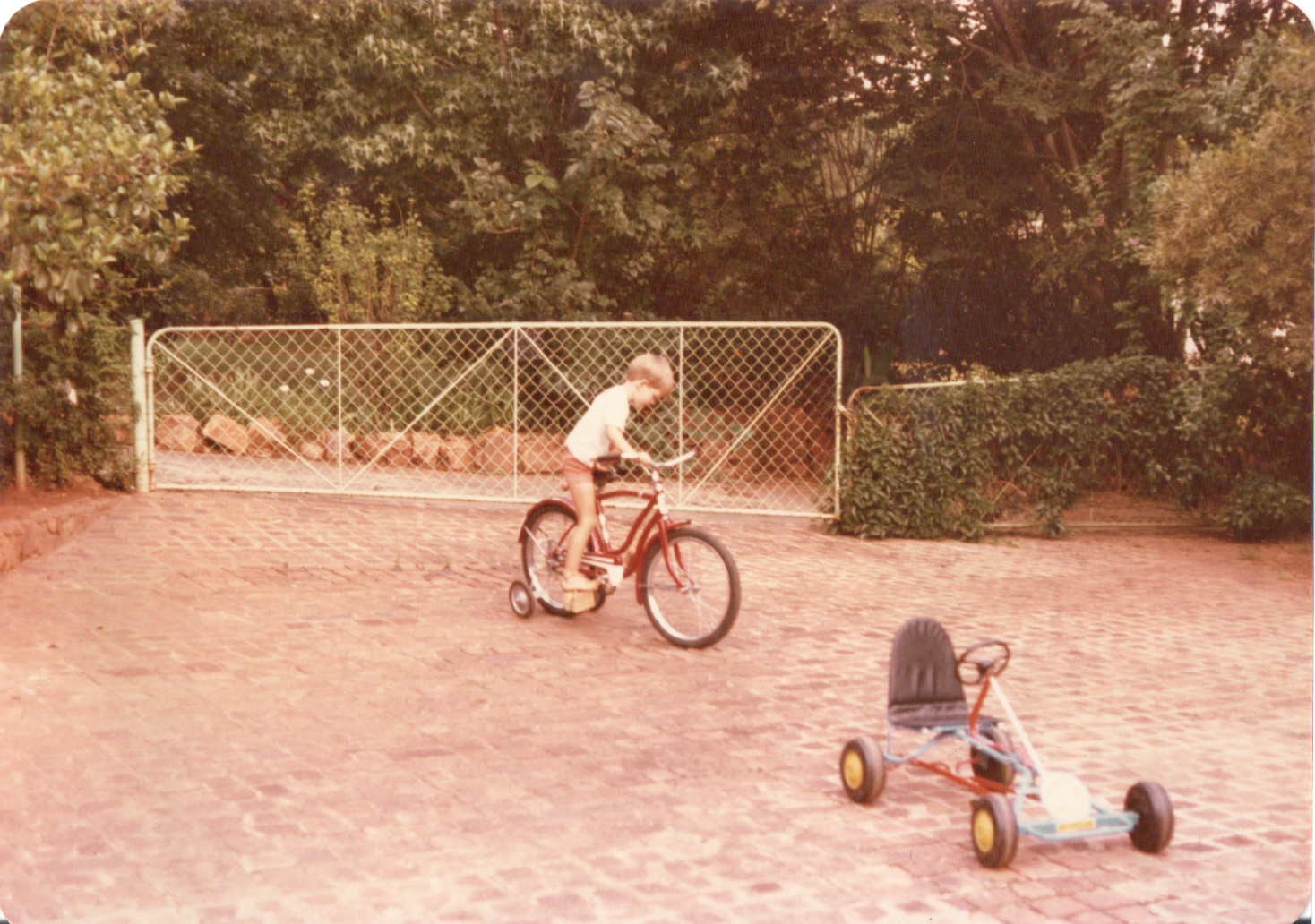
It was there that my parents bought
me a bright red bicycle with training wheels. That bicycle gave a four-year-old
boy a tremendous sense of freedom.
I also had white rabbits and two
black Labrador dogs that seemed enormous to me at the time.
One of my most vivid memories from
that house is my fourth birthday party in 1977. My mother baked a train-shaped
cake decorated with colourful sweets. Friends and cousins ran around the garden
while we played games and chased each other across the lawn.
It was a simple moment, but it
remains one of my happiest childhood memories.
The house belonged to a medical
doctor who eventually decided to sell it. He offered my parents the first
opportunity to buy it for forty thousand rand.
Today that amount would hardly buy
a used car.
In the late 1970s it was a fortune.
My parents simply could not afford it, and we had to move again.
 |
| On my red bike - Rietondale (1977) |
My great grandmother was still alive during those days. My dad was the apple of her eye as her oldest grandchild, and I the oldest great-grandchild. Favoritism in my family is an acceptable practice. Because dad was favored, his siblings and even his own mother resented him for it.
When she died in 1980, dad was slowly ostracised by his own family and his younger brother and his children, were favored by my grandmother. Because my dad lost his father at a young age, and his mother lacked the necessary emotional skills to raise him, he was brought up by his grandparents.
So when his grandmother died, it was as good as his other parent dying. She was the rock in his life and losing her shook him hard.
 |
| With my great grandmother - Rietondale, Pretoria (1977) |
Kindergarten
Between 1977 and 1978, during my pre-school years, I attended Katie Kagan Kindergarten near the Pretoria Zoo—a place that remains vividly etched in my memory. The days seemed simple, yet rich with small rituals that have stayed with me for life.
I remember the sandpit where we played endlessly, the jungle gym and swings beneath the shade of old oak trees, and the comforting routine of shared meals—rice, chicken, carrot salad, followed by custard and jelly for dessert.
There were quiet nap times that I resisted, and the gentle rhythm of flannel board Bible stories, especially the story of Joseph in his colourful coat, which captured my imagination. My cousin Marcu was there too, and together we shared those early moments of discovery and mischief.
Looking back, I now understand that this kindergarten was part of a broader legacy shaped by Katie Kagan, a social activist who helped establish early childhood education in Johannesburg, ensuring that young children had access to care and learning environments.
My kindergarten report noted, “Henry loves singing, and helping everyone, but he finds it difficult to sleep.” In many ways, that simple observation captured something enduring about my nature—a restless, sensitive spirit, drawn to people and expression, yet never entirely at ease in stillness.
 |
| Kindergarten pic of me |
Schubert Park Flats
The house in Rietondale belonged to
a medical doctor who eventually decided to sell it. He gave my parents the
first option to buy the property, but it was simply outside their budget. Today
forty thousand rand would hardly buy a well-worn second-hand car, but in the
late 1970s it was a fortune.
Needless to say, we had to move
again.
This time the change was extreme in
the opposite direction.
We moved into a small flat on the
twentieth floor of the Schubart Park apartment complex in the inner city of
Pretoria. The wide garden, the hill behind the house, the rabbits, and the dogs
were suddenly gone. Instead there were elevators, concrete corridors, and the
constant noise of city life far below.
There were no gardens, no bicycles,
and very little space for a young boy to run around. I suspect that is one of
the reasons my mother decided we needed a television—to keep us sane inside
that small apartment.
It was the first television we ever
owned.
I was almost six years old and I
have no memory of watching television before that moment. It was a Philips
colour TV, and I still remember the very first program I saw. It was a sports
show called Sport 1979. The presenter had the most remarkable seventies
look—an enormous Afro hairstyle, thick sideburns, and a wide striped tie that
seemed to glow on the screen.
I also remember watching the series
Heidi, dubbed into Afrikaans.
Despite the limitations of
apartment living, my mother spent a great deal of time with me in that flat.
She bought puzzles, books, and educational toys and patiently worked through
them with me. She also taught me how to read and write.
By the time I entered school I was
already well ahead in those areas.
Of course, life in the apartment
also provided plenty of opportunities for mischief.
My cousin Marcu, who was the same
age as I was, often visited. The two of us had a remarkable ability to get into
trouble together. On one occasion we threw eggs from the twentieth floor onto
people walking below on the pavement. At the time it seemed hilarious to us.
On another occasion we filled our
mouths with water and sprayed it onto my baby brother while he lay in his crib.
Unfortunately for us, my mother
caught us in the act.
The punishment that followed was swift and memorable.
 |
| With my plastic yellow scooter - Pretoria (1975/6) |
There are two other vivid memories from that time that have stayed with me over the years.
The first occurred after one of my parents’ arguments. My mother left the apartment after a fight with my father. She did not take me with her but left me there with him. She spent the night at her sister’s house and returned the following day.
I cannot remember exactly how I felt at the time, but looking back now I imagine the uncertainty must have been confusing for a five-year-old child. When a mother suddenly disappears, even for only a night, a young mind cannot know whether she will return or not. That kind of uncertainty, even if temporary, leaves its mark.
The second memory also involved my mother and a moment of childhood recklessness.
One day we were walking together into the city. At some point I suddenly broke free from her hand and ran across a very busy road. By sheer luck I made it safely across without being struck by a car, but my mother nearly suffered a heart attack from the fright.
I was quickly informed that my father would hear about what had happened.
Naturally I spent the rest of the day in nervous anticipation, waiting for him to return home from work and deliver the inevitable punishment.
 |
| My fifth Birthday party with Carla, a cousin and aunt Fe, mom's sister - Schubert park flats (1979) |
My parents were both strict
disciplinarians, and mistakes were usually punished with the belt, a shoe, or
whatever instrument happened to be within reach. The philosophy of the time was
simple: spare the rod, spoil the child.
I cannot clearly remember why I received so many hidings. Perhaps I was a strong-willed child who needed to be “broken,” as people often said in those days. Or perhaps my parents simply did not have the tools to deal with a restless, curious boy who struggled to sit still and rarely accepted “no” as a final answer.
A New Brother
My younger brother Gerhard was born
in 1979 while we were living in Schubart Park.
Unlike my birth, his delivery went
smoothly. My parents were prepared for complications and everything proceeded
without incident.
For the first time I had a sibling.
I remember the day my father and I
went to the hospital to fetch my mother and the baby. I felt incredibly proud.
After several years of being an only child, the idea of having a little brother
felt exciting.
Looking back today, I sometimes
wish I had protected him more carefully. Childhood curiosity and the influence
of cousins occasionally led to foolish behaviour that I regret now.
 |
With my new baby brother Gerhard - 1979 |
The Bushveld Farm
Another important part of my childhood during those years was my father’s family farm in the Bushveld near Koedoeskop in what is today, Limpopo Province. The farm was called Doornfontein, and it held a special place in my father’s life because it was where he had grown up.
After my grandfather died, my father’s mother remained a widow for thirteen years before remarrying a man named Paul de Kock, who was ten years younger than she was. When she was forty-five, she became pregnant again but sadly suffered a miscarriage. After that loss they decided to adopt a little blond boy who happened to be exactly the same age as I was.
He effectively became my playmate and, in family terms, my “uncle.”
Many weekends we travelled from Pretoria to visit my grandparents on the farm. In those days the road to Koedoeskop was still a long dirt road, and the journey of roughly 140 kilometres could take more than four hours. Today the same distance can be covered in just over a quarter of that time, but in those days the trip felt like a real expedition into the countryside.
For a young boy, the farm felt like paradise.
I spent many holidays there with my grandparents and my adopted “uncle,” and we quickly became close friends. The farm offered endless opportunities for adventure. We walked for miles through the veld and the surrounding hills, exploring every corner we could find. We swam in the creek and the farm dam, helped herd cattle, and sometimes accompanied the adults down to the river for picnics.
We built houses out of mud, raced our toy cars through the dirt, and threw mud at each other with great enthusiasm. I clearly remember that we both had bright yellow plastic scooters that we rode around the yard.
 |
| Happy days - On the farm with my step 'uncle' and my cousin Daleen |
Those days remain some of my most vivid childhood memories.
My great-grandmother was still
alive during that time. Because my father was her oldest grandchild, he was
very much the apple of her eye. In turn, I was her oldest great-grandchild.
Favoritism in my family was not
unusual.
Because my father was so clearly
favoured by his grandmother, resentment slowly developed among his siblings and
even his own mother. When my great-grandmother died in 1980, the balance within
the family shifted dramatically. Without her presence, my father gradually
found himself pushed to the margins of his own family.
But during those early years I knew
nothing of those tensions.
To me, the farm was simply a place of adventure, freedom, and childhood exploration.
 |
| On the farm - 1978 |
Only much later did I begin to understand how complicated the situation surrounding the farm had become.
As the oldest son, my father had
originally been entitled to inherit the farm. Wanting to include his siblings
fairly, he agreed that the inheritance should be shared, and my grandmother
changed her will accordingly. Eventually the farm was placed into a trust.
Despite repeated attempts, my
father has never been allowed to see a copy of that trust.
He was permitted to select a
section of the farm that he could use privately. On that piece of land stands a
house of considerable value. For a time tenants lived there and paid rent
directly to him.
Over time, however, the situation
changed. Through various manoeuvres and family dynamics, his siblings gradually
positioned themselves around the property and effectively pushed him out of it.
Eventually his brother moved into the house on that land without asking
permission and without paying any rent.
To this day he continues living
there and making decisions about the property as though it were his own.
The situation became even more
painful years later when my parents divorced after thirty-three years of
marriage. In the process both of them lost their home and their pensions. Even
today, well into their seventies, they both still have to work in order to make
ends meet.
Meanwhile my uncle and his wife
receive pensions and also benefited financially from selling their own
property. Yet despite living in the house that stands on my father’s portion of
the farm, they have never offered him a cent in rent—even during extended
periods when he was unemployed and had no source of income.
My grandmother has always favoured
her second son above my father, and this favoritism has created a deep rift
within the family. In many ways my father was replaced by the new family that
formed after her remarriage.
Not only was blood placed against
blood, but the adopted child and my step-grandfather were often favoured above
her own eldest son.
Because my brother and I were
connected to my father, we were also denied a place of honour within that side
of the family. My brother experienced it even more intensely than I did.
Looking back now, I believe this
family dynamic had ripple effects far beyond the farm itself. My mother had
endured rejection from her mother-in-law for years, and in some ways she
carried that pain forward. When my brother was born and became the focus of her
affection, she may have been unconsciously compensating for the rejection she
herself had experienced.
In the end, I sometimes feel that I
inherited a similar fate to my father’s.
Favoritism and rejection have a way
of echoing across generations.
Yet when I think back to those
early visits to the farm, I do not first remember the conflicts or the
inheritance disputes.
I remember the wide open Bushveld,
the smell of dust and grass, the endless walking through the veld, and the
simple joy of childhood adventures.
The World Around Us
Growing up in Pretoria in the 1970s
felt safe for white children. We could travel almost anywhere in the city, even
at night, without worrying about crime.
At the same time South Africa was
living under the Apartheid system. Political tension was never completely
absent. At school we were shown posters of weapons and explosives that
authorities warned could be used in attacks by anti-government groups.
Bombings and attacks occasionally
occurred during the 1980s, such as the Church Street bombing in Pretoria. Yet
despite these events, everyday life for many white families continued with a
sense of normality and security.
That world would eventually change
dramatically.
A Move Toward Stability
By the time I approached school
age, my parents were determined to create greater stability for our family.
After years of moving between
rental houses, my father finally managed to secure a bank loan to purchase a
home in a suburb called Mountain View.
I was six years old.
And without knowing it, I was about
to enter the most stable chapter of my childhood.
Picture highlights
 |
| Engaging with a bird - Hartbeespoort dam (1977) |
 |
| Taking a nap with my bear |
 |
| Going to church |
 |
| On the beach |
 |
| So many toys |
The story continues in part 3
Read it here

No comments:
Post a Comment