Showing posts with label spices. Show all posts

Wednesday, 12 November 2008

Exploring Tuti island - The island in the Nile River

English Teacher in Khartoum

Sudan 2008


I taught English as a second language in Khartoum during 2008. Sudan with its huge UN and other NGO presence is not really a popular holiday destination for anyone. I prefer working in these undiscovered developing countries where one can still find the real culture, unspoiled and untrampled by tourists and tour buses. I explored Khartoum mostly by foot, sometimes in searing heat, taking pictures for which I got arrested once. The president at that time Mohammed Al Bashir was indicted by the World Court for crimes against humanity. At that time civil war still existed between the North and the South, the oil-rich South seeking independence from the Arab North. 

The bridges across the Nile into Khartoum proper were perfect insertion points for the Southern rebels. I wanted to take pictures of the bridges, and other Khartoum street scenery, which was considered an act of espionage. Fortunately, after lots of prayers, I was released after my true identity was discovered. Hence taking pictures was quite a challenge for a snap-happy chappy like myself. To continue my obsession I had to devise plans not to be seen. Most of the pictures I took of bridges and other politically sensitive positions had to be done from the hip, like a gun-slinger.

Tuti island - across the river, Khartoum proper

About Sudan


Sudan (Arabic: السودان Al-Sudan) is the third largest country in Africa and sixteenth largest in the world, bordering Egypt, Eritrea, Central African Republic, Chad, Ethiopia, Libya, and South Sudan.  Sudan is afflicted by civil wars which have been raging, on and off, for more than 40 years. When the colonial map-makers divided up Africa, they included in Sudan the predominantly Muslim people of the north (including Nubians), who share much of their history and culture with Egyptians and Arabs, and the largely Christian and Animist Nilotic and Bantu people of the south, who have more in common with the rest of sub-Saharan Africa than with their northern neighbours (Wikitravel).

About Khartoum


Khartoum (Arabic: الخرطوم Al-Khartum) is the capital of Sudan and is located where the Blue Nile and White Nile Rivers merge. The huge, spread-out city is actually made out of three distinct cities (Khartoum, Khartoum North or Bahri, and Omdurman) which are divided by the Nile and its two arms. The Blue Nile flows between Khartoum and Bahri, the White Nile between Khartoum and Omdurman, and the merged Nile between Bahri and Omdurman. The confluence of the Blue and White Nile, known as Al-Mogran, lies just north of the bridge between Khartoum and Omdurman (Wikitravel). Divided by the Niles (Blue and White Nile, which confluence at Tuti island), Khartoum is a tripartite metropolis with an estimated overall population of over five million people, consisting of Khartoum proper, and linked by bridges to Khartoum North called (al-Kharṭūm Baḥrī ) and Omdurman (Umm Durmān ) to the west. (Wikipedia)

About Tuti island


Tuti Island (also spelled Tutti Island) is an island in Sudan where the White Nile and Blue Nile merge to form the main Nile. It is surrounded by the "Three Towns": Khartoum (the capital of Sudan), Omdurman (the largest city in Sudan), and Khartoum North (also known as Bahri, a large industrial center). Despite this, Tuti is home to only one small village (founded in the late 15th century), with grassland being the main makeup of the island. In the past, the only approach to Tuti Island was via several ferries that cross the river every so often, but now the Tuti Bridge, a modern suspension bridge, has been completed and can be used instead. Tuti Island is mainly agricultural and where Khartoum gets most of its supply of fruits and vegetables and therefore, you can find many farms situated all around the island, many of them still using manual methods of farming. You will find acres of green fields and lime groves. Its eight square kilometers (three square miles) of fertile land is covered in citrus orchards, vegetable farms, gorse hedgerows and narrow muddy lanes where donkeys and rickshaws are the main source of transport (Wikipedia).


Crossing the Nile from Khartoum to Tuti island

Crossing the Nile from Khartoum to Tuti island - the suspension bridge into Tuti

Sudanese ferry passengers

The Nile ferry that took us across

Sudanese truck at arrival point on Tuti island
Burj Al Fateh hotel in the background

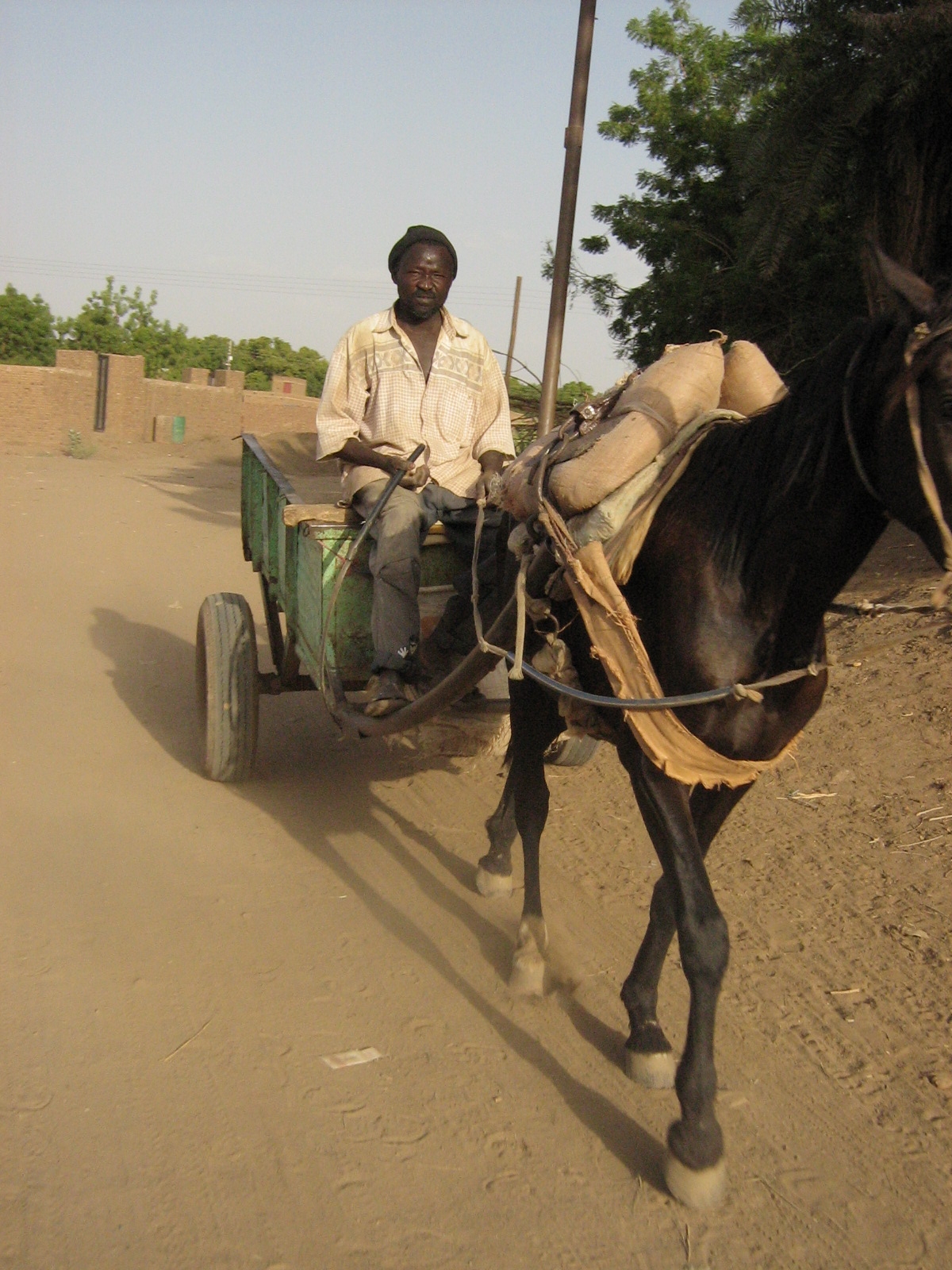
Horse cart - Tuti island & Burj Al Fateh hotel across the Nile

My local guides and Raksha driver on Tuti island
 
Local fisher boy -Tuti island

My Raksha driver posing on an old 'rust bucket' with farmland in the background

Donkey car - Tuti island

Ferry arrival spot....not sure whether these goods were 'import' or 'export' goods

Ferry arrivals - Tuti island

On Tuti island

I took a ferry from Khartoum near the Burj Al Fateh hotel. The rust bucket took several with us....without life vests.....across the Nile. A Raksha driver approached me on the other side and offered to show me the island....for a price of course. Other Sudanese joined in to aid in the tour. I took some pics and a couple of hours later he took me to the ferry departure point. It was not expensive at all and I had a good couple of hours experiencing rural life.

Wednesday, 10 September 2008

Khartoum Souqs (markets)

English teacher in Sudan

Khartoum 2008


During 2008, I spent nearly 6 months in Khartoum, Sudan, as an EFL teacher. Sudan is not your typical tourist destination. Most of the expat community either work for NGO's or for oil companies, and are not there for pleasure. There are rarely tourists who visit Sudan, due to safety considerations. It is not a place where one can freely walk and happily snap away pictures. I found visiting souqs to be the exception to the rule. In this photo expose I focus on the souqs or markets that I frequented in Khartoum and Omdurman
.


Spices for sale - Omdurman souq


About Sudan


Sudan (Arabic: السودان Al-Sudan) is the third largest country in Africa and sixteenth largest in the world, bordering Egypt, Eritrea, Central African Republic, Chad, Ethiopia, Libya, and South Sudan.  Sudan is afflicted by civil wars which have been raging, on and off, for more than 40 years. When the colonial map-makers divided up Africa, they included in Sudan the predominantly Muslim people of the north (including Nubians), who share much of their history and culture with Egyptians and Arabs, and the largely Christian and Animist Nilotic and Bantu people of the south, who have more in common with the rest of sub-Saharan Africa than with their northern neighbours (Wikitravel).

About Khartoum


Khartoum (Arabic: الخرطوم Al-Khartum) is the capital of Sudan and is located where the Blue Nile and White Nile Rivers merge. The huge, spread-out city is actually made out of three distinct cities (Khartoum, Khartoum North or Bahri, and Omdurman) which are divided by the Nile and its two arms. The Blue Nile flows between Khartoum and Bahri, the White Nile between Khartoum and Omdurman, and the merged Nile between Bahri and Omdurman. The confluence of the Blue and White Nile, known as Al-Mogran, lies just north of the bridge between Khartoum and Omdurman (Wikitravel).

About Omdurman


Omdurman (standard Arabic: أم درمان‎‎ Umm Durmān) is the second largest city in Sudan and Khartoum State, lying on the western banks of the River Nile, opposite the capital, Khartoum. Omdurman has a population of around 3 million, and is the national centre of commerce. With Khartoum and Khartoum North or Bahri, it forms the cultural and industrial heart of the nation (Wikipedia).

What is a souq?


A souq or souk, also spelled shuk, shooq, soq, esouk, succ, suk, sooq, suq) is a marketplace or commercial quarter in Western Asian and North African cities. The equivalent Persian term is "bazaar". A souq was originally an open-air marketplace. Historically, souqs were held outside cities at locations where incoming caravans stopped and merchants displayed their goods for sale. Souqs were formed whenever a caravan or caravans arrived. Since this might be infrequent, souqs often extended beyond buying and selling goods to include major festivals involving various cultural and social activities. Any souq may serve a social function as being a place for people to meet in, in addition to its commercial function (Wikipedia).


Spices for sale at a local souq in Buri nearby my home

Buri Souq

On one of the main roads in Khartoum, goats are on display alongside the road to be sold


Omdurman Souq


The largest and most famous souq in Sudan
Little boy at his father's shop - Omdurman souq

Omdurman souq scenery - soccer fans on a bus driving by celebrating 

Scooter and corn - Omdurman souq

Omdurman souq

Omdurman souq

Omdurman souq

Khartoum-North souq (Saad Gishra)


This is a covered market place, and it is Bahri’s main shopping market. Prices here can be a little higher than those in souq Omdurman however it is much more easily navigable for tourists.


A friend, Justine buying freshly squeezed fruit juice at a market in North Khartoum

Khartoum North souq

Khartoum North souq - a tailor fixing Justine's hand bag

Khartoum North souq - spices galore

More Spices

Khartoum-North souq

Khartoum-North souq

Khartoum-North souq

Khartoum-North souq

Khartoum-North souq

Khartoum-North souq

One can almost find anything possible at the souqs, from clothing and cheap plastic household items to food and jewelry. They are also much cheaper than in regular shops. But one must go there for the sights the sounds and the smells, it is where one can find the heart of the people and the city. It is a fantastic opportunity to engage with locals. It was one of my favorite outings in Sudan. It was safe, cheap, fun, relaxing and one could take photos freely. This is an authentic cultural interaction opportunity you should not miss, whether you stay in Khartoum or whether you are just passing through.